

Key Takeaways
The accusation: you don't have to explain anything about the incident (Angaben zur Sache).
Your personal details: they must never be false. If the authority needs them, provide or correct them (Angaben zur Person).
The date on the form is a request. It is not the 2-week objection deadline. That deadline only starts with a formal fine notice (Bußgeldbescheid).
No fine, no points, no ban yet. A hearing form is an investigation step.
Keep the letter and the envelope, and watch your mail.
An Anhörungsbogen is the German traffic authority's way of saying: "We think a traffic rule was broken with your car. Do you want to comment?" It's not a fine, and you don't have to admit anything.
This guide shows you which letter you have, what you must fill in, what you can leave blank and what happens next. Each section is short, so you can skip to the part you need.
Not sure what your letter means?
Get your letter checked: your role, your dates and your options, explained in English.
Hearing form, witness form or fine notice
Which dates matter for you
Whether a ban or points are at stake
German words you'll see on the latter
German | English |
|---|---|
Anhörungsbogen | Hearing form |
Zeugenfragebogen | Witness questionaire |
Bußgeldbescheid | Formal fine notice |
Bußgeldstelle | Traffic fines authority |
Aktenzeichen | Case reference number |
Tatvorwurf | The allegation |
Angaben zur Person | Personal details |
Angaben zur Sache | Statement of the incident |
Betroffene/r | Person concerned (accused) |
Verwarnungsgeld | Warning fine (minor offences) |
Einspruch | Objection |
Zustellung | Formal service of a document |
What is an Anhörungsbogen?
A hearing form (Anhörungsbogen) is a letter from a traffic fines authority (Bußgeldstelle) about an alleged traffic violation. In most cases it follows a speed camera or red-light photo.
What it lists: date, time, place, number plate and the allegation. Sometimes there's a photo.
Why you got it: usually because the car is registered to you. That doesn't prove you were driving.
What it is for: to give you the chance to comment before the authority decides.
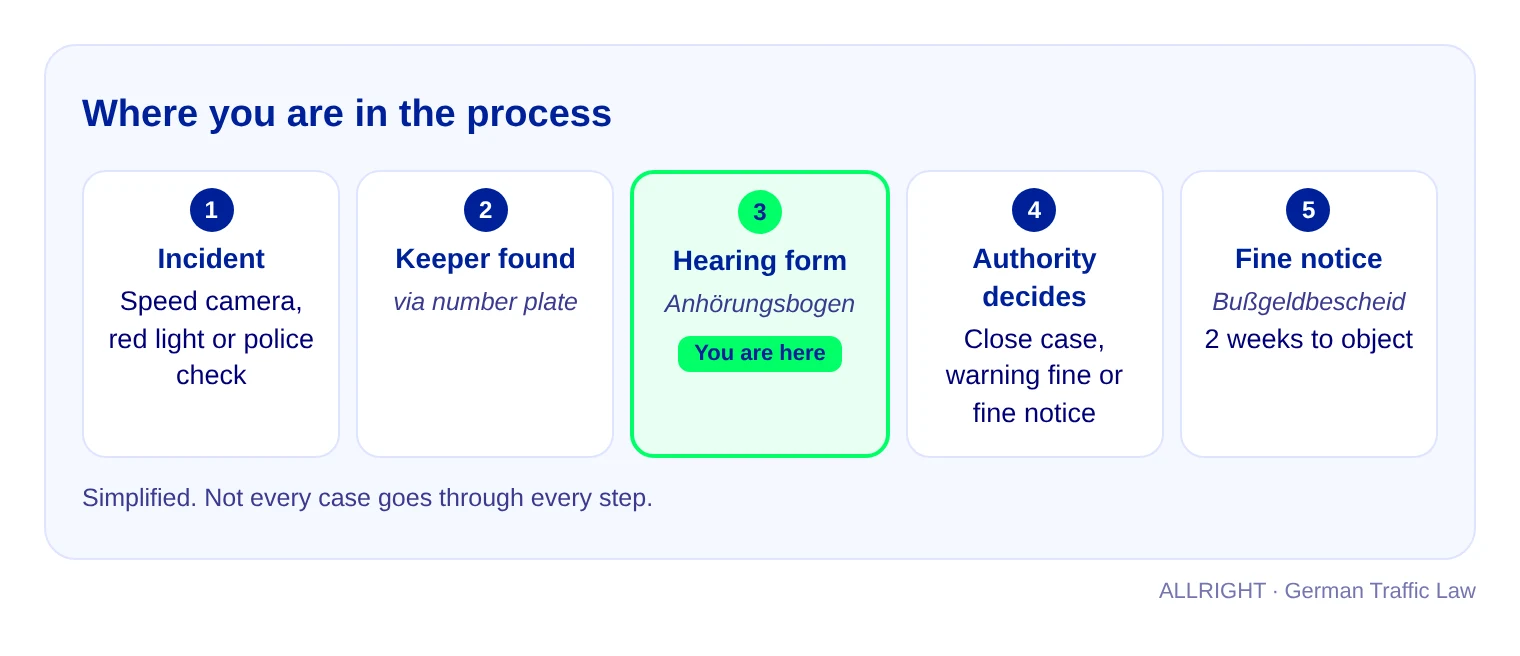
Legal basis: § 55 OWiG
You must be given the chance to comment on the accusation. It's a chance, not a duty.
Administrative offence or criminal case?
Most hearing forms concern an administrative offence (Ordnungswidrigkeit), like speeding. If the letter mentions a criminal offence (Straftat), for example leaving the scene of an accident, different rules apply. Get legal advice before you reply.
Which letter did you get?
Check the heading first. Similar-looking letters mean very different things.
Letter | Words to look for | What it means | What to do now |
|---|---|---|---|
Hearing form | Anhörung, Betroffene/r | You are treated as the person concerned | Check your details. Commenting is optional. |
Witness questionnaire | Zeuge / Zeugin | You are asked about someone else, often the driver | Check your witness rights. |
Warning-fine offer | Verwarnungsgeld, Zahlungsfrist | Minor offence, warning fine of €5–55 | Pay within the period (usually 1 week) to close the case, or don't pay and the case continues |
Formal fine notice | Bußgeldbescheid, Rechtsbehelfsbelehrung, Einspruch | The authority has decided | Note the service date. The objection deadline is running. |
Unsure? Contact the authority and quote the reference number (Aktenzeichen).
Do you have to fill it in and send it back?
Every hearing form has a part you must not get wrong and a part you can leave blank.
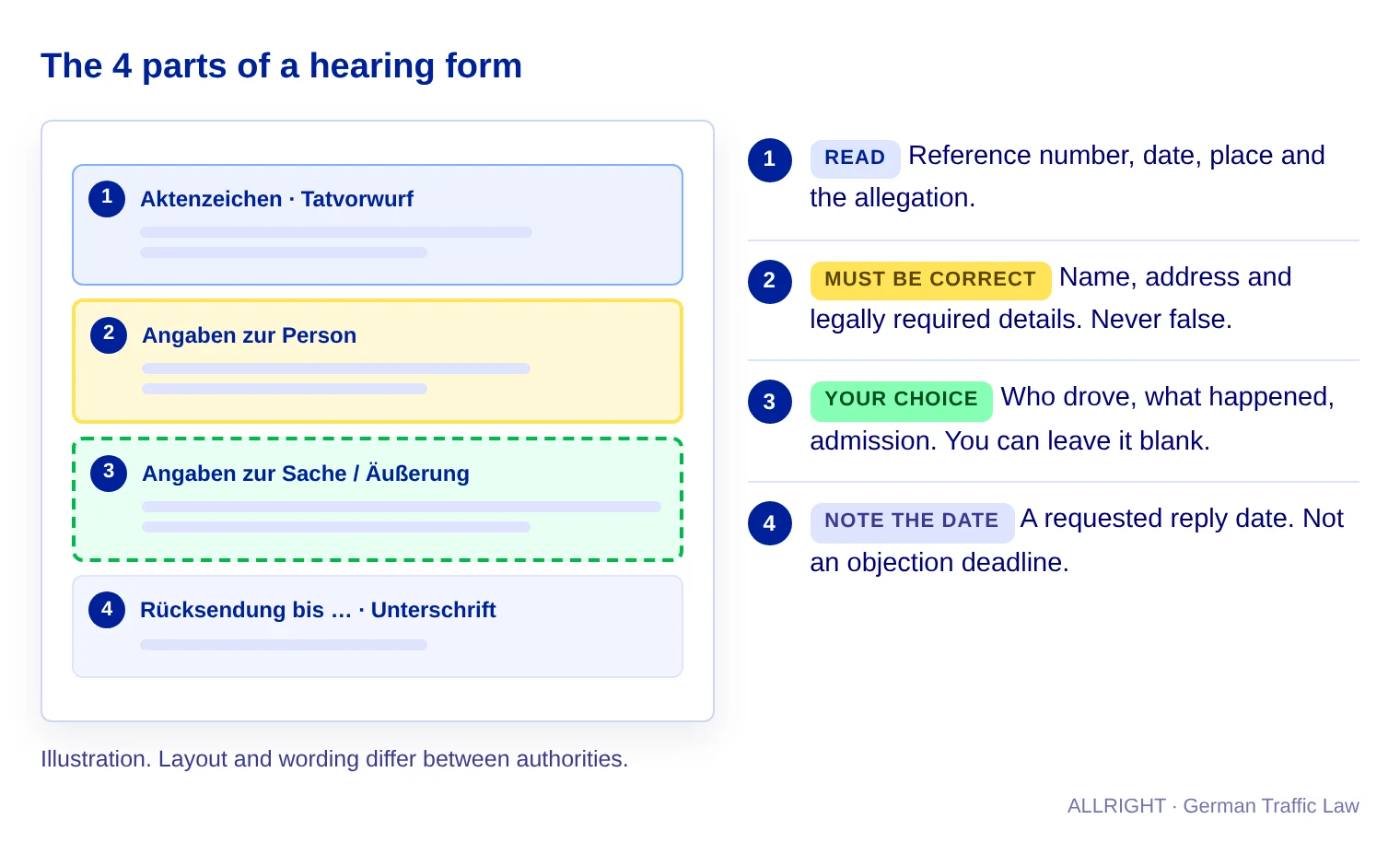
Personal details: name, address and other details required by law. You must not give false details. You must not refuse them if the authority is entitled to ask (§ 111 OWiG).
The incident: who drove, what happened, why, and whether you admit it. You can stay silent here. Your silence can't be used against you as an admission.
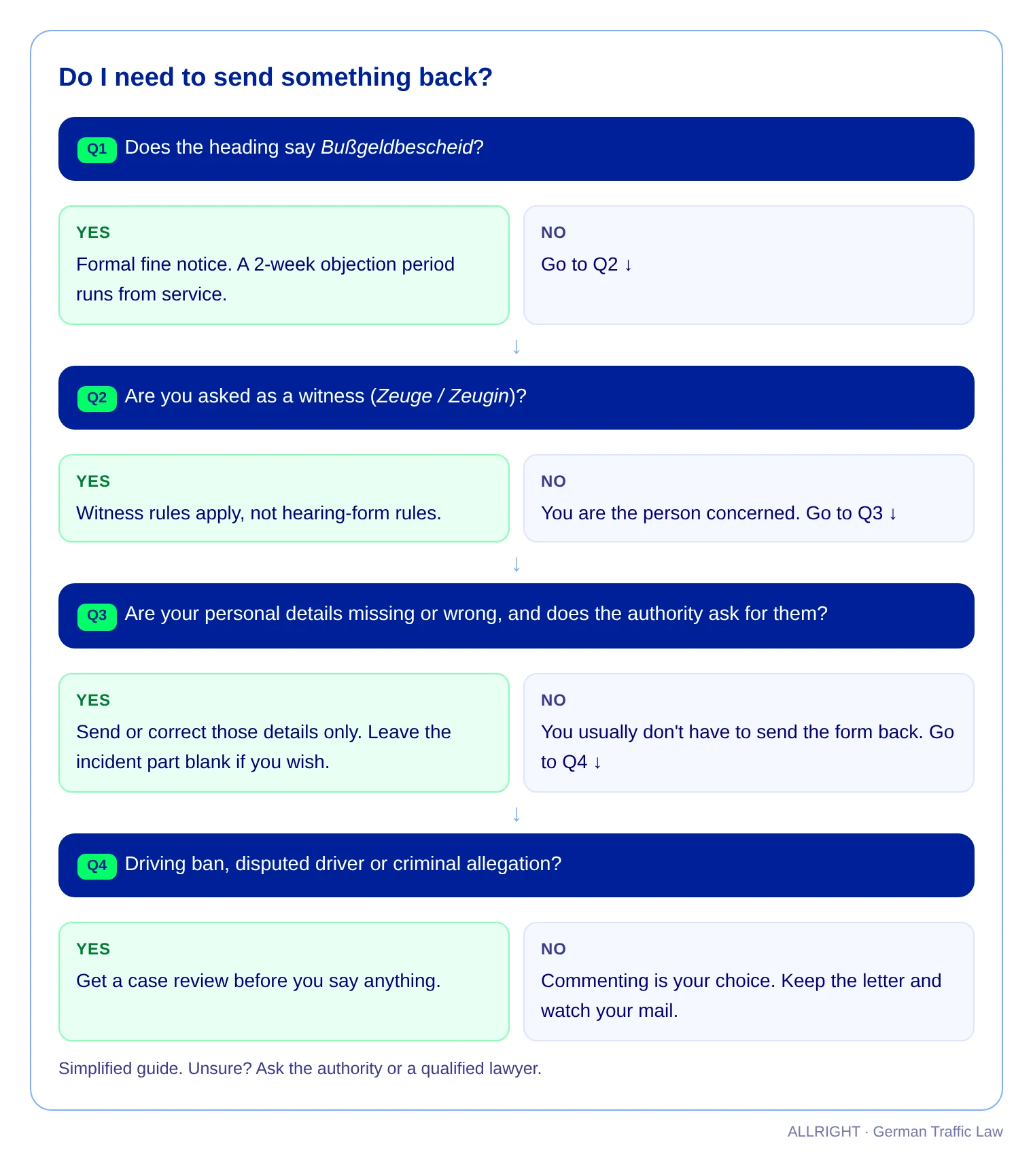
Details already correct? Then you don't usually have to send the form back.
Legal basis: § 111 OWiG
Giving false personal details, or refusing them when an authority is entitled to ask, is a separate offence. This rule doesn't make you return every form.
Quick decision: do I need to send something back?
It was me: can I just pay?
If you were driving and want it over quickly, that's a valid choice. Just know how it works:
You can't pay a hearing form itself. There's nothing to pay until you receive a payment request with a reference number.
Small offences: you may get a warning-fine offer (Verwarnungsgeld, €5–55). If you pay correctly within the period, the case is closed for that offence.
Bigger offences: the authority issues a formal fine notice. Fees and expenses are added to the fine.
Admitting doesn't usually lower the fine. Standard fines come from the national fine catalogue (Bußgeldkatalog). You can admit in part 3 of the form, but you don't have to.
Before you admit anything, check this
Could the offence lead to a driving ban (Fahrverbot) or points?
Is the photo or measurement doubtful?
Do you need your licence for work?
If any answer is yes, get a case review first. A statement is hard to take back.
Avoid fake fine letters
Only pay to an account named on an official notice from a public body (for example a city or state treasury, Stadtkasse or Landeskasse), and always use the reference number. Be wary of emails or text messages asking you to pay traffic fines.
What does the date on the form mean?
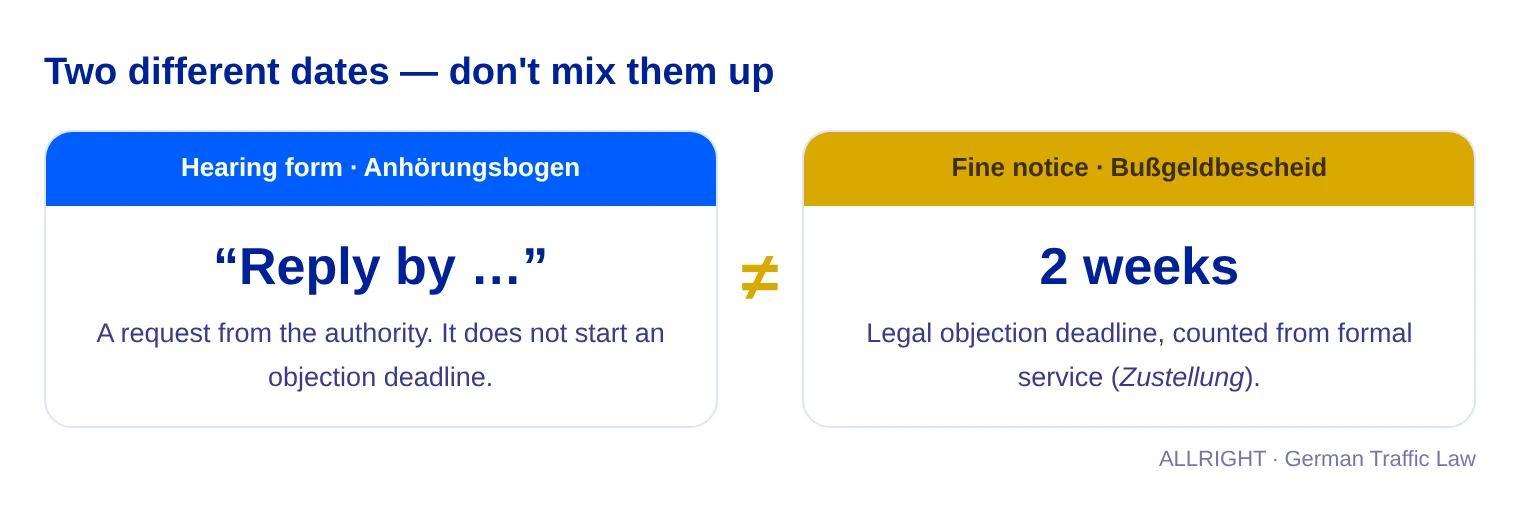
The only hard deadline comes later
Once a formal fine notice has been served (Zustellung), your objection (Einspruch) must reach the authority within 2 weeks (§ 67 OWiG). Keep the envelope (often yellow): it shows the service date.
Example: Maya in Munich
Hearing form: speeding on the A9, "reply by 26 October". Maya checks her name and address, finds them correct and chooses not to comment. Three weeks later a fine notice arrives. Its service date is the one she plans around.
Can the case expire?
Most traffic offences (§ 24 StVG) now expire after 6 months, up from 3 months (§ 26(3) StVG).
The clock usually starts on the day of the offence.
Certain steps by the authority restart the clock, for example ordering your hearing (§ 33 OWiG). This can happen even if you never reply.
Alcohol and drug offences (§ 24a StVG) follow different rules.
Bottom line: don't rely on the case expiring. Online advice based on the old 3-month rule is out of date.
What if you weren't the driver?
Owning the car doesn't make you guilty. The authority has to identify the actual driver.
You can stay silent about who was driving if you are the person concerned.
Never name an innocent person. A false accusation can be a criminal offence.
The authority may investigate further, for example by comparing the photo with ID records or asking the police to make enquiries.
Got a witness questionnaire instead?
Close relatives (for example a spouse, parents or children) may have the right to refuse to testify (§ 52 StPO via § 46 OWiG). This right never allows false statements.
Possible consequence: logbook order (Fahrtenbuchauflage)
If the driver can't be identified after a significant offence, the keeper may have to keep a driving logbook for future trips (§ 31a StVZO). This isn't a fine and isn't proof you committed the offence, but it is a real administrative burden.
Can you see the evidence?
Yes, within limits. Seeing the file (Akteneinsicht) shows you what the authority relies on. This matters most if the driver's identity or the measurement is disputed.
Ask the authority for file access and quote your reference number (Aktenzeichen).
Check the photo and the details: date, place, vehicle and measured speed.
For technical doubts about the measurement, a lawyer usually requests the full file including measurement data.
A blurry photo doesn't automatically end a case, and a technical challenge needs evidence, not guesswork.
Court decision: access to measurement data
Germany's Federal Constitutional Court held that a fair trial can require access to relevant measurement information, even if it is not in the court file. This is subject to limits, and refusal doesn't automatically cancel the ticket.
Rental car, company car or foreign licence
The hearing form means the same thing. What changes is how the authority found you and what else might follow.
Situation | What usually happens | Watch our for |
|---|---|---|
Rental car | The rental company gives your details to the authority. You then get the hearing form. | A separate handling fee from the rental company. It is not the official fine. |
Company car | Your employer receives the letter first and may pass on your name or forward the form. | Your employer may face a logbook order if no driver is named. Check your car policy. |
Foreign number plate | German authorities can ask other countries for keeper details. | Cross-border enforcement rules depend on the country. |
Foreign driving licence | The hearing form rules are the same. | A later ban can stop you driving in Germany. EU and non-EU licences are treated differently, so get advice. |
Can I reply in English?
Official procedures in Germany are in German. An English reply may be delayed or not processed properly.
Use a translation to understand the letter, but reply in German. The template below is in German and comes with an English reading aid.
Not understanding German doesn't stop deadlines. Act on time anyway.
What happens if you ignore it?
If you were the driver and your details are correct, ignoring the form doesn't make you guilty, but it doesn't make the case go away either.
The authority continues without your input and may issue a fine notice.
If the driver is unclear, it may investigate further (photo comparison, police enquiries).
For the keeper, an unidentified driver can lead to a logbook order.
The one thing you must never ignore is a formal fine notice.
What happens after the hearing form?
Situation | What usually happens | Watch our for |
|---|---|---|
Discontinuation notice | Case closed | Which case and which allegation it covers |
Request for more information | The investigation is continuing | Your role, what they want and the reply date |
Warning-fine offer | Simplified solution for minor offences | Amount and payment period (usually 1 week). Correct payment closes the case for that offence. |
Formal fine notice | Fine, possibly points or a driving ban | Allegation, fees, service date, objection deadline |
Four terms are easy to mix up:
Fine (Bußgeld) ≠ fees and expenses (Gebühren und Auslagen). Both appear on a fine notice.
Points go into the driving-fitness register (Fahreignungsregister) in Flensburg, and only for qualifying offences.
Driving ban (Fahrverbot): a temporary ban of 1–3 months. You hand in the licence card for that time, but you keep your driving entitlement.
Licence withdrawal (Entziehung der Fahrerlaubnis): you lose the licence and must reapply.
Amounts depend on the exact offence and the date. See our speeding ticket guide for typical figures.
Your 60-second checklist
Photo or scan of all pages and the envelope
Heading checked: hearing form, witness form, warning fine or fine notice?
Name, address, vehicle and reference number checked
Allegation, date, place and reply date noted
Personal details (must be correct) kept separate from the incident part (optional)
No false names, and no innocent person named
If you reply: copy kept, with proof of sending
Driving ban, disputed driver or criminal allegation? Get a case review
Watching the mail for a formal fine notice
Need to ask the authority a neutral question without commenting on the incident? Use this short template.
Template: ask the authority to clarify your role
What it says in English: "I received your letter. Please confirm whether you're writing to me as the person concerned or as a witness, and which personal details you still need. I'm not commenting on the allegation at this time."
[VOR- UND NACHNAME]
[ANSCHRIFT]
An [BEHÖRDE / ANSCHRIFT]
[ORT], [DATUM]
Aktenzeichen: [AKTENZEICHEN]
Betreff: Anhörungsbogen – Bitte um Klärung
Sehr geehrte Damen und Herren,
ich habe Ihr Schreiben vom [DATUM DES SCHREIBENS] erhalten. Bitte bestätigen Sie, ob ich in diesem Verfahren als betroffene Person oder als Zeuge/Zeugin angeschrieben werde und welche Angaben Sie zu meinen Personalien noch benötigen.
Zu dem Tatvorwurf mache ich derzeit keine Angaben.
Mit freundlichen Grüßen
[NAME]
Conclusion: a hearing form is your chance to comment, not a fine
Getting an Anhörungsbogen can feel alarming, especially when the letter is in German. But at this stage, the authority is only asking whether you want to comment. You haven't been fined, given points or banned from driving.
Your job right now is simple. Check that your personal details are correct. Then decide whether you want to say anything about the incident. You don't have to. If it was you and you just want the matter over with, wait for the payment request or the fine notice. There's nothing to pay on the hearing form itself.
The letter that really counts is the one that may come next. If a formal fine notice (Bußgeldbescheid) arrives, write down the date it was served. From then on, you have 2 weeks to object.
If a driving ban, a disputed driver or a criminal allegation is involved, get a case review before you make any statement. A statement is hard to take back.
Frequently asked questions
How Allright can help you
German traffic letters are hard to read, especially in a second language. We explain what yours means in English and show you when legal help is worth it.
Understand your letter
Identify the letter type
Know which dates count
See your options
When legal help makes sense
Disputed driver identity
Possible driving ban or points
Criminal allegation or unclear service