Calculator

Severance pay in Germany: estimate yours in 2 minutes

Find out what a realistic severance pay (Abfindung) could look like, and what to do next. In plain English, no sign-up needed.

Expert-reviewed by Paul Krusenotto

Start here

Severance Pay Calculator

Important: A calculator result does not create a legal entitlement to severance pay. In Germany, a payment called Abfindung - compensation connected with the end of employment - is often negotiated or agreed, rather than automatically owed.

Severance Calculator

Your Gross Monthly Salary

Your gross salary per month, before tax. If your income varies: enter the monthly average.

Years of Service

Enter the length of your current employment relationship.

How Old Are You?

Your age can, alongside other factors, influence your negotiating position.

How Many Employees Work at Your Company?

Has Your Employer Given You a Formal, Written Termination Letter?

Please note: The actual severance pay may differ significantly in individual cases from the estimate calculated here. Decisive factors include individual circumstances such as age, maintenance obligations, severe disability, social plan (Sozialplan), collective agreement, and the economic situation of the employer. Severance payments are generally subject to tax and can affect entitlement to unemployment benefits. Your details are used exclusively for the calculation and processed in accordance with the GDPR and German data protection law (BDSG). The result does not constitute individual legal advice and has no legally binding effect. No liability is accepted for the correctness and completeness of the calculation.

What you get

What this page helps you do

1

See a realistic range

Know if an offer is low, fair or generous before you react.

2

Understand the number

See which factors raise or lower it in your case.

3

Pick your next step

Negotiate, get a check or simply stay informed.

How it works

How is severance pay calculated in Germany?

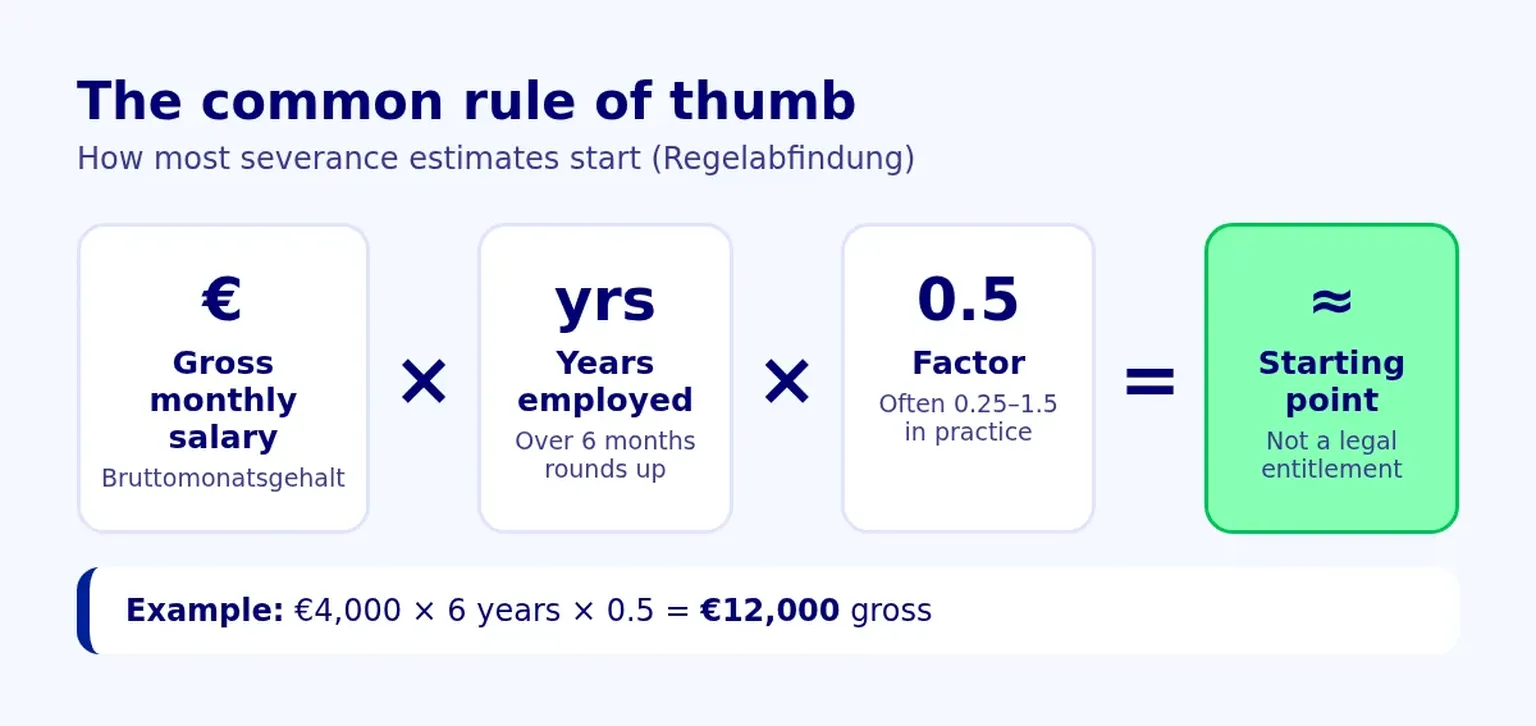
There's no single legal formula. A widely used orientation formula combines your gross monthly salary, years of service and a factor. It helps explain an estimate, but it's not a fixed tariff.

Infografik zur Berechnung einer Regelabfindung: Bruttomonatsgehalt × Beschäftigungsjahre × Faktor 0,5 als Ausgangspunkt.

Worked example

Input

Value

Gross monthly salary

4,000 €

Years employed

5 years 8 months → 6 years (rounded up)

Factor

0.5

Estimate (gross)

12,000 €

This shows the arithmetic only. It's not a personal result, a prediction of what you'll get, or proof that payment is due.

Why people talk about "0.5"

§ 1a of the Dismissal Protection Act (Kündigungsschutzgesetz, KSchG) sets 0.5 monthly earnings per year of service for one specific route: an operational dismissal where the letter contains the required offer and the employee lets the 3-week claim deadline pass. It's not a standard entitlement for every termination.

The three inputs explained

1

Gross monthly salary (Bruttomonatsgehalt)

Follow the calculator's definition. In court-set severance, § 10(3) KSchG counts money and benefits in kind due for regular working time in the last month. Don't assume bonuses are included unless the calculator says so.

2

Years of service

Use your actual start date and expected end date. Rounding up more than six extra months to a full year comes from § 1a KSchG. Negotiated agreements may count differently.

3

The factor

0.5 means half a gross monthly salary per year of service. It doesn't reflect how strong your case is, your negotiating leverage or the value of other contract terms.

Your factor

What pushes the amount up or down?

The 0.5 is a starting point. Your real factor depends on how strong your position is.

  • Dismissal looks legally weak

  • Long service, older age, dependants

  • Protection against dismissal applies (KSchG)

  • Special protection, e.g. works council, pregnancy, disability

  • Small business (10 or fewer employees)

  • Employed less than 6 months

  • Strong reason for dismissal

  • 3-week deadline to sue missed

Understand

What your result means, and what it doesn't

Treat the result as a starting point. It reflects the information entered and the calculator’s verified method; it does not decide whether you have a claim or what an employer will agree to pay.

It's an estimate

Change the inputs and the result changes. Double-check salary, dates and the factor.

It's not an automatic right

German law gives no general right to severance. Specific situations can create one, but most payments are negotiated.

It's not cash in hand

A gross figure is before tax. What you keep depends on your personal tax situation.

How to read the result view

1

Find the amount label.

Check whether the real interface calls it gross, net or simply an estimate.

2

Review your inputs.

Compare the figures shown with your contract, payslip and employment dates.

3

Check the method.

Look for the factor, rounding and any explanation of what is included.

4

Keep the limits in mind.

The calculation is separate from legal entitlement, negotiation and tax treament.

Before you rely on it

Three simple checks before you rely on the estimate

Use figures from your documents

Have your employment contract, a recent payslip and your start date ready. If a field asks for gross pay, don't enter net pay.

Check dates, units and definitions

Make sure years and months are entered correctly. Read the help text for the factor rather than assuming it means the same in every case.

Keep the result with its assumptions

A number without the salary, service period and factor behind it can mislead. Note them down, then compare with any real offer.

Decide

Choose the route that matches your situation

The right next step depends on what has already happened. Select the card closest to your situation and use the checklist in order.

I want an initial benchmark

Use the result as a reference point, not a target or promise.

  1. Check all calculator inputs.

  2. Note the formula and assumptions.

  3. Collect your contract, recent payslips and relevant amendments.

  4. Read the sections on entitlement, tax and unemployment benefit.

My employer has offered severance

Do not compare only the headline amount. Identify what the offer is intended to settle.

  • Gross or net wording

  • Employment end date and notice period

  • Paid release from work (Freistellung)

  • Holiday, bonuses and other outstanding pay

  • Employment reference (Arbeitszeugnis)

  • Waiver or full-and-final settlement clauses

  • Tax, unemployment and residence implications

I have a written termination notice

Kündigung is the German term for dismissal or termination by notice. Record the exact date on which the written notice reached you.

Key deadline: A Kündigungsschutzklage — a claim asking the Labour Court to review whether the dismissal ended the employment — generally has to be filed within three weeks after receipt of the written notice.

  1. Secure the letter and document the delivery date.

  2. Check the three-week court deadline immediately.

  3. Register as a jobseeker on time with the Agentur für Arbeit, the Federal Employment Agency.

  4. Then place the calculator estimate in the wider assessment.

Jobseeker registration is generally due no later than three months before employment ends. If you learn of the end less than three months in advance, the statutory period is three days after learning of it.

I have been offered an Aufhebungsvertrag

An Aufhebungsvertrag is a mutual termination agreement. It covers more than severance and should be read as a package.

  1. Compare the proposed end date with the applicable notice period.

  2. List every payment, benefit and non-financial term.

  3. Check unemployment-benefit and tax consequences.

  4. Check work-based residence consequences if relevant.

  5. Only then assess the severance amount.

Where employment ends against compensation before the employer’s ordinary notice period has run, entitlement to unemployment benefit may be suspended until the date on which employment would have ended with that period observed. A separate waiting-period issue may also arise depending on why employment ended.

Dismissed or offered an agreement?

Have your situation checked before the deadline runs out or before you sign anything.

Go deeper when needed

Severance pay in Germany: the essential guide

What does Abfindung mean?

Abfindung is a payment connected with the end of employment. It may be negotiated in a mutual termination agreement, agreed in a Labour Court settlement or arise under a specific legal route. Dismissal itself does not automatically produce a severance claim.

When does severance become relevant?

Route

What happens

Legal basis

Negotiated exit

You and your employer agree on an end date and a package

Contract / Aufhebungsvertrag

Court settlement

A dismissal dispute ends with a settlement that includes a payment

Settlement (Vergleich)

Offer in the dismissal letter

Operational dismissal with offer; you let the claim deadline pass

§ 1a KSchG

Court ends employment

Court dissolves employment and sets appropriate severance

§§ 9, 10 KSchG

Social plan

Collective arrangement, e.g. during restructuring

Sozialplan

What can influence the amount?

Gross pay, service and a factor explain a benchmark. A real package can also reflect:

  • Your legal position and the stated reason for dismissal

  • Notice periods and litigation risk

  • Outstanding pay, holiday and bonuses

  • Paid release from work and the employment reference

  • The scope of any waiver clause

None of these guarantees that the figure moves in a particular direction.

Does age change the formula?

Age should not be added as an automatic multiplier in a general calculator. Age and service can matter in specific legal contexts, but the applicable rule must be identified first. A general age uplift would be misleading.

How is severance taxed?

Do not treat a gross estimate as spendable cash. A severance payment is generally relevant for income tax. Under certain conditions, section 34 of the German Income Tax Act (Einkommensteuergesetz or EStG) provides a special calculation for qualifying extraordinary income. This is commonly discussed as the Fünftelregelung, or “one-fifth method”. The name describes a tax-calculation mechanism; it does not mean that only one fifth of the payment is taxable. Eligibility and the actual effect depend on the individual tax position and tax year.

Are social-security contributions due?

German Pension Insurance states that genuine compensation for losing a job is not subject to social-security contributions. A payment that actually settles previously earned contractual claims can be treated differently. The label used in an agreement is therefore not the only relevant point.

Can severance affect Arbeitslosengeld?

Yes, it can. There are two separate mechanisms, and they're easy to confuse:
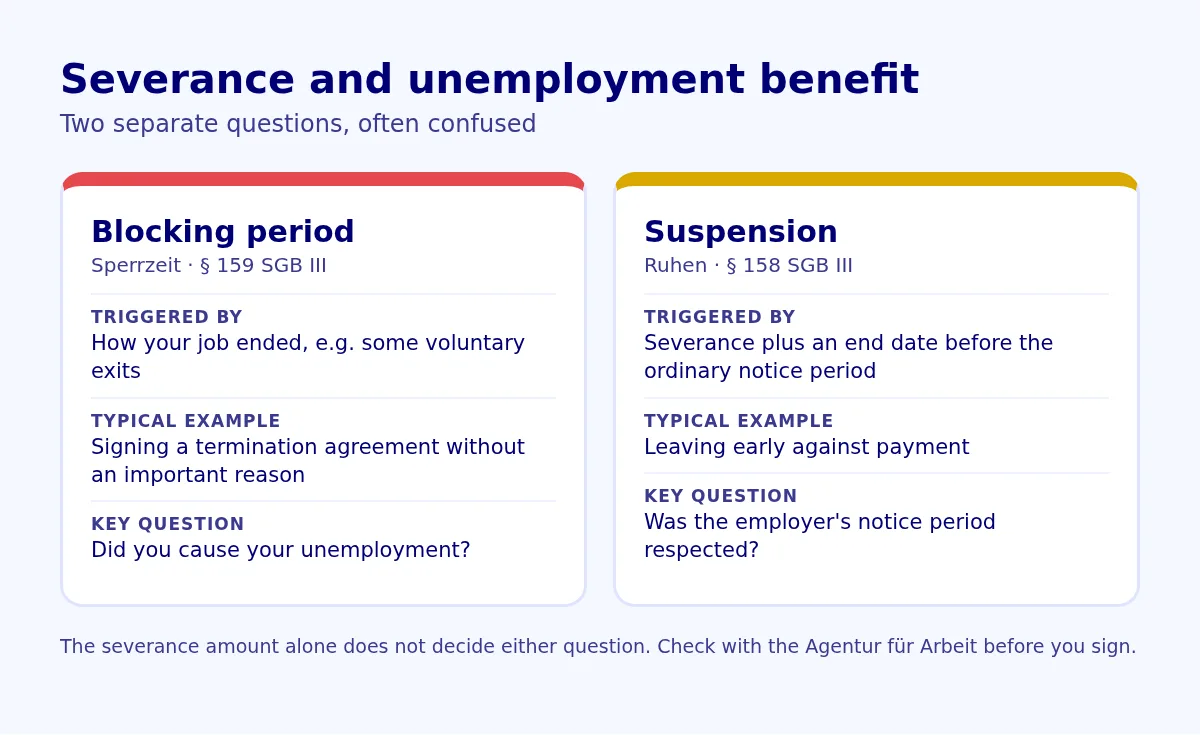
Infografik vergleicht Sperrzeit (§159 SGB III) und Ruhen (§158 SGB III) bei Abfindung und Arbeitslosengeld mit Auslösern und Schlüsselfragen

Arbeitslosengeld usually means contribution-based unemployment benefit. Effects are possible, but two concepts should not be collapsed into one:

  • Sperrzeit: a waiting or blocking period that may arise because of how unemployment was caused, for example in some voluntary-exit situations.

  • Ruhen: suspension of payment for a period, including a potential issue where employment ends against compensation before the employer’s ordinary notice period has elapsed.

The severance amount alone is not enough to decide either question.

What does Kündigung mean?

Kündigung is termination by notice from one party, such as an employer’s dismissal. German law generally requires dismissal to be in writing. If you want a Labour Court to review whether it ended the employment, the three-week period for a Kündigungsschutzklage is a central issue.

What is a Kündigungsschutzklage?

It is a dismissal-protection claim filed with the competent Arbeitsgericht, or Labour Court. Its legal purpose is to establish that the dismissal did not end the employment. It is not simply an application asking the court to calculate severance.

What is an Aufhebungsvertrag?

It is a mutual agreement to end employment. Because the employee agrees to the end date and package, the consequences can differ from receiving a unilateral dismissal. Review the full document, including notice, benefits, release from work, reference wording and waiver clauses.

What is the Agentur für Arbeit?

It is the local office of the Federal Employment Agency. Jobseeker registration (arbeitssuchend melden) and unemployment registration (arbeitslos melden) are distinct steps. The statutory jobseeker-registration timing can apply even while a dismissal is being challenged.

What is the Ausländerbehörde?

It is the local foreigners authority responsible for residence-law matters. If your right to work or stay is linked to a particular job or salary, obtain title-specific information rather than relying on the severance calculation.

Read the detailed guide
kostenlose-ersteinschaetzung

Frequently asked questions

Severance calculator FAQs