
Key Takeaways
EU/EEA licence: keeps working while valid. No exchange needed for a normal car licence.
Any other licence: six months from the day Germany becomes your home (ordentlicher Wohnsitz).
Your Anmeldung is not day one. The clock usually starts when you actually move in.
Here for 12 months or less? Apply for an extension of up to six months. It's not automatic.
A pending application is not a permit. After six months, driving without cover can be a criminal offence.
Can you use a foreign driving licence in Germany after moving here? Often yes, but the answer depends on the country that issued it, whether you have established ordinary residence in Germany, and whether the licence remains valid for the vehicle you drive.
The key distinction is between EU/EEA licences and licences from elsewhere. If your non-EU recognition period may be ending, check your position before you next drive.
Facing a Fahrverbot?
Check the notice before you surrender your licence, drive, or miss the Einspruch deadline.
Understand the German terms in your notice
Check if the four-month rule applies
Clarify appeal options before the deadline expires
EU/EEA or not: which rules apply to your licence?
It all depends on the country printed on your licence, not your passport. A Canadian with a French licence follows EU rules. A French citizen with a Canadian licence follows non-EU rules.
Does Germany recognise your EU or EEA driving licence?
A valid driving licence issued by an EU member state or another EEA state is generally recognised in Germany within its licensed categories. You do not usually have to exchange an ordinary car licence merely because you move here.
However, the recognition rules have exceptions, for example, certain provisional documents, specific residence irregularities, existing bans or withdrawals, and special validity rules for some heavy-vehicle classes.
EU / EEA Licence
Can I keep driving?
Yes, while the licence is valid.Must I exchange it?
No, it's voluntary for a car licence.Watch out for
Provisional licences, bans, and code 70 on the card.
Non-EU / -EEA Licence
Can I keep driving?
Yes, for six months after you move here.Must I exchange it?
Yes, to keep driving after that.Watch out for
Your start date, translation rules, tests.
EU licence code 70?
Code 70 means an EU country swapped your original non-EU licence. Germany may then look at the history of the original licence, so don't assume EU rules apply automatically.
How long can you drive with a non-EU driving licence?
If your licence was issued outside the EU/EEA, you can normally drive for six months after establishing ordinary residence in Germany, provided the licence is valid, covers the vehicle class and meets Germany’s other recognition conditions. This is a six-calendar-month rule, not a universal 180-day period. Visitors without ordinary residence may be treated differently.
Important: six months is a recognition limit
Once the statutory recognition period ends, you must not assume that a still-valid foreign licence card or a pending exchange application lets you continue driving. If you may be near the end of the period, contact your licensing authority and arrange other transport until the position is clear.
§ 29(1) FeV — third-country licences
Plain-English summary (not an official translation): when a holder of a third-country licence establishes ordinary residence in Germany, their domestic driving entitlement generally continues for six months. A limited extension is possible on application.
When does the six-month period begin?
The period is linked to when you establish ordinary residence (ordentlicher Wohnsitz) in Germany—not automatically the day of your address registration (Anmeldung). German licensing law generally looks at where you ordinarily live because of personal or professional ties, with the 185-days-per-year criterion and special rules for certain cross-border circumstances and students.
Definition: ordinary residence
Ordinary residence is a legal assessment of your real home base and connections, not simply the date stamped on a registration certificate. Where you normally live because of personal or work ties, generally at least 185 days a year. It can start on day one of your move. You don't have to wait 185 days. Your arrival, work, accommodation and personal circumstances may all matter.
Example: Maya moves to Hamburg
Maya relocates from Toronto and starts living and working in Hamburg on 10 January 2026. She registers her address on 2 February 2026. Her registration date does not automatically move the six-month recognition period to August. The relevant starting point needs to be assessed from when she established ordinary residence. Her clock most likely started in January, not February.
Keep documents showing when you moved and began living here. When a start date is genuinely disputed, avoid a self-calculated “safe” final driving day without professional or authority confirmation.
Can you extend the six-month driving period?
Possibly. The local driver licensing authority (Führerscheinstelle) may extend recognition by up to another six months if you apply and credibly demonstrate that your ordinary residence in Germany will last no more than twelve months in total.
It is not an automatic entitlement just because you have a fixed-term contract.
Practical tip: apply before the period ends
If you know your stay is temporary, gather evidence such as a contract or study appointment showing your planned end date and ask the authority what it needs for a § 29 FeV extension. Keep written confirmation of any decision; do not treat submission as approval.
Do you need a translation or international driving permit?
Carry your valid original national driving licence. Depending on the issuing country, language and document format, § 29(2) FeV may also require a translation. An international driving permit (Internationaler Führerschein) can help evidence an entitlement in recognised circumstances but does not independently create one. It normally travels with the underlying national licence.
Expat note: not every licence needs the same translation
The translation requirement contains statutory qualifications and exceptions, including recognised licence formats and issuing states. Do not pay for a document simply because a general website says every foreign licence needs one. Confirm the precise requirement with the competent authority or an official motoring source.
Which documents do you need in the car?
Always your original national licence. Some licences also need a translation or an international driving permit (Internationaler Führerschein) next to them.
Document | What it does |
|---|---|
National licence | Proves your entitlement and class |
International driving permit | Replaces a translation |
Translation | Makes your licence readable for police |
Extension decision | Proves your new end date |
You usually don't need a translation if your licence is written in German, was issued in the EU, EEA or Switzerland, or follows the international format of the 1968 Vienna Convention.
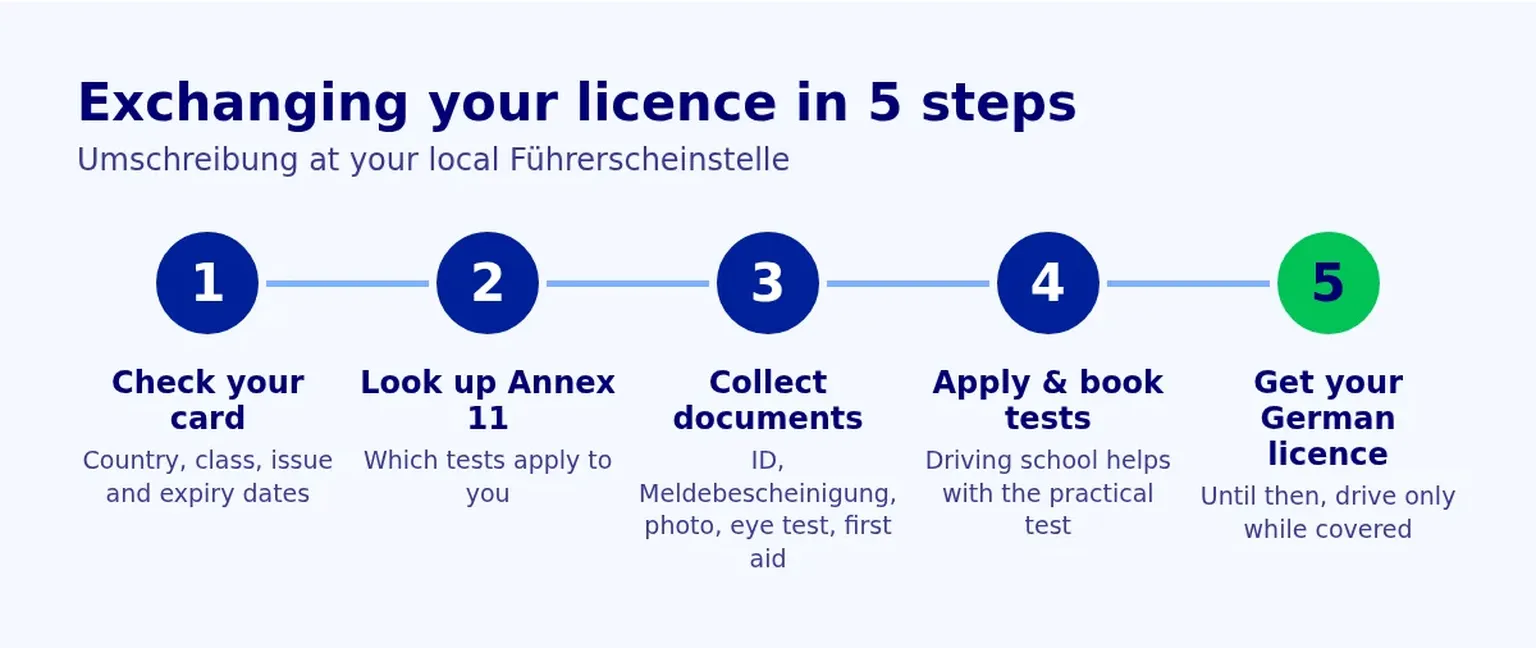
How do you exchange a foreign licence for a German licence?
If your third-country licence will cease to be recognised after six months and you want to continue driving here, start the German licence-issuance or exchange process in good time.
Your local authority will tell you which application route applies. The required documents can include proof of identity and residence, your original licence, photos, and supporting evidence or examination results depending on your case.
The exchange is called Umschreibung. Apply at the Führerscheinstelle of the city or district where you live. On its website, search for "Umschreibung ausländische Fahrerlaubnis".
The authority may retain or return your former licence according to § 31 FeV and applicable arrangements. Do not assume every applicant must produce an identical package: some requirements differ by licence class and exchange route.
Application preparation checklist
Find the website for your competent Führerscheinstelle and its official exchange form
Check your original licence is current and covers the vehicle category
Confirm the country and vehicle category against Annex 11
Ask which identity, residence, photograph and translation documents are required
Ask whether theory and/or practical tests apply
Keep the submission confirmation and check processing times
Do you need to take driving tests?
That depends on Annex 11 (Anlage 11 FeV). It lists countries and licence classes, sometimes with footnotes.
Annex 11 identifies certain issuing countries and classes for simplified German licence issuance. The table states whether a theory test or practical test can be waived. A country can qualify for one class but not another, so checking only the country name is not enough.
There are four possible outcomes:
No tests
Theory test only
Practical test only
Both test
Even if you need tests, you don't have to do the full beginner training. A driving school will usually still help you prepare and book the practical test.
Your licence situation | Typical route | What you must verify |
|---|---|---|
EU/EEA-issued, valid category B | Normally recognised without exchange | § 28 exclusions, validity and class |
Third-country, Annex 11 lists class and waives both tests | Simplified issuance may be available | Exact country, class and Annex notes |
Third-country, Annex 11 requires one test | That test may be required | Which examination and applicable conditions |
Third-country not covered for the class | Theory and practical testing may be required | § 31(2) training exemption and local process |
Important distinction: qualifying third-country exchange applicants who need examinations are not automatically subject to the full mandatory driving-school training programme applicable to first-time German applicants. A driving school may still help you prepare and arrange practical testing.
What about UK licences, rental cars and foreign plates?
A UK-issued licence is generally treated as a third-country licence after Brexit. The specific exchange requirements depend on the applicable Annex 11 entry, class and relevant notes.
For rental cars, company cars and foreign-plated cars, the vehicle’s ownership or registration country does not extend your personal right to drive in Germany. Rental companies and employers may also impose contractual licence checks.
What if your six months are already over?
That's not the same as forgetting your licence at home. Driving without a recognised licence can be driving without a licence (Fahren ohne Fahrerlaubnis), a criminal offence under § 21 StVG. It can also cause trouble with your insurance after an accident.
Criminal-law consequence - do not keep driving
If the six-month period has ended and no valid extension or German entitlement applies, stop driving until your legal position is confirmed. Under § 21 StVG, intentional and negligent conduct are treated differently; the actual outcome is case-specific. Seek German-qualified advice if you have already been stopped, charged or involved in an accident.
Do German driving bans and points apply to foreign licences?
Yes. Germany may impose traffic-law consequences affecting your ability to drive here even if the licence card was issued abroad.
Points in Flensburg, a driving ban (Fahrverbot) or a licence withdrawal (Entziehung der Fahrerlaubnis) can stop you driving in Germany, even if your licence is still valid at home.
Measure | What it means for you |
|---|---|
Penalty points (Punkte) | Qualifying offences can be recorded in Germany’s driver-fitness register; consequences depend on the offence and applicable rules. |
Driving ban | You must not drive within the scope and duration of the ban. |
Licence-entitlement withdrawal | A more serious decision affecting legal permission to drive; a foreign document does not neutralise restrictions in Germany. |
This guide does not publish a speeding-fine tariff or offence-specific points table because it is about licence recognition, not a particular traffic offence. Any such table in a separate case guide must state the offence date and verified catalogue version.
How do you surrender your licence for a Fahrverbot?
If the Fahrverbot becomes final, you usually must surrender your licence document to the authority named in the notice. The ban period normally starts only when the authority has the document or when the legal rules otherwise trigger the start. This is why timing and proof matter.
Verified court decision: residence can affect exchange eligibility
The Federal Administrative Court held that a foreign licence extended by the issuing authority while its holder had ordinary residence in Germany could fall outside German recognition under § 29(3) FeV; the holder could not demand simplified German issuance on that licence under § 31 FeV. The holding concerns the specific residence-and-extension situation, not every foreign licence.
What should you do before driving again?
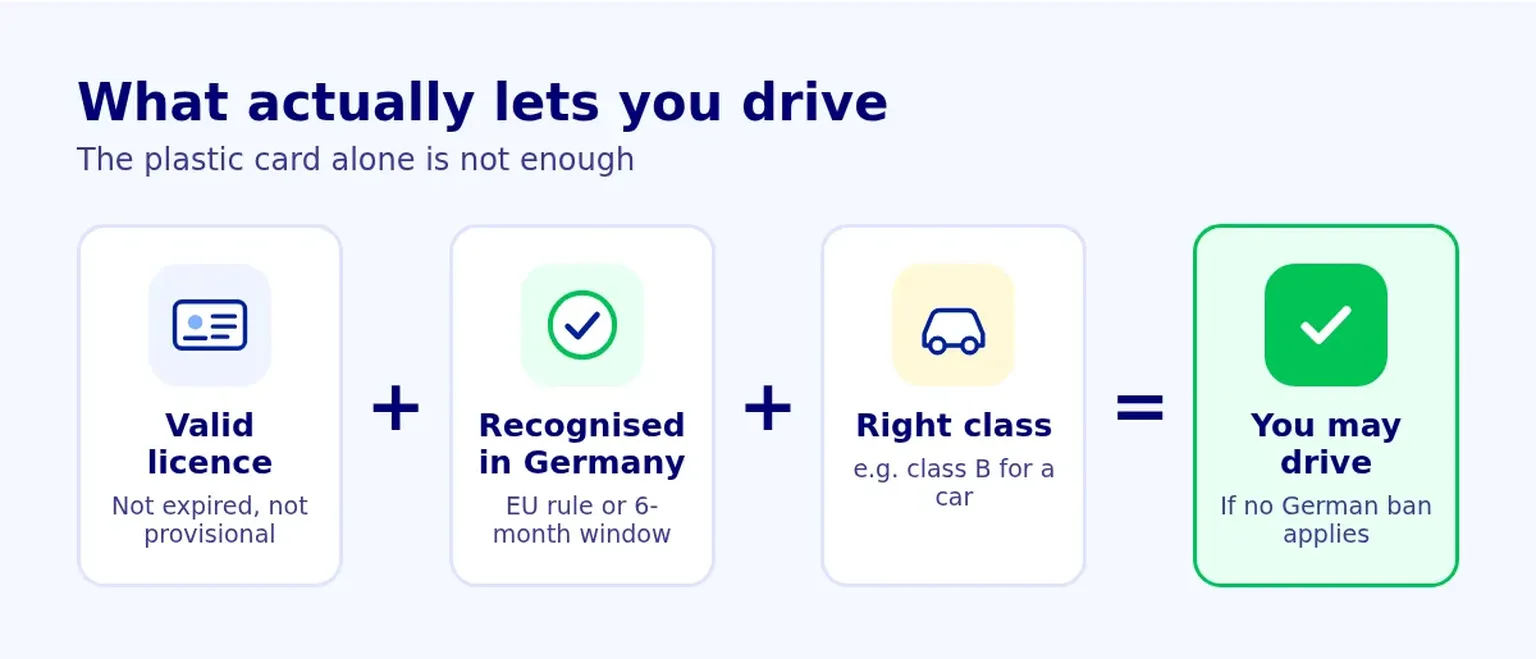
Start by checking your personal driving entitlement rather than relying on the expiry date on the plastic card. Work through these steps before booking a trip, renting a car or driving to work.
Before-you-drive checklist
Identify the actual issuing state and vehicle class on your licence
Check that the licence is valid and not provisional or restricted
Determine whether and when you established ordinary residence in Germany
If non-EU/EEA, verify the six-month period and whether any extension was granted
Check whether a translation or international permit is required
If exchanging, read § 31 FeV and the exact Annex 11 country/class entry
Do not drive if recognition has expired or a German ban/withdrawal applies
Keep copies of documents and written correspondence with the authority
Frequently asked questions
Conclusion
A foreign driving licence can be valid for driving in Germany even after a move—but the recognition rules depend on the issuing state, your ordinary residence and the licence itself. EU/EEA licences are generally recognised subject to exceptions, while non-EU/EEA licences are commonly subject to a six-month residence-based period. Start the exchange process early if needed and do not treat an application as permission to keep driving. If the facts are uncertain or criminal proceedings have begun, obtain individual German legal advice.
About Us - Allright
Allright helps expats in Germany understand their rights as drivers. Fines, points, driving bans — German traffic rules can be confusing, especially when the letters are in German. We break it down in plain English, so you know exactly where you stand.
What matters to us
Quick Start: A short online check tells you what's going on and what to do next.
Direct Contact: Real answers from real people, digitally.
Honest Assessment: We tell you the truth about your chances — even if that means a different path.
How can Allright help you?
Flensburg Points Check: See how many points you have and what they mean.
Free Initial Assessment: Tell us what happened, get a quick read on your options.
Lawyer Referral: Connect with a traffic law attorney to review your case.
Get a free assessment now — turn uncertainty into a plan.